

Intelligent Monetary Policy: Greenspan and the End of Forward Guidance (Part One of Three)

Dr. Alan Greenspan’s passing is a sharp reminder that information arbitrage has always been the ultimate key to accumulating wealth and steering modern society.
During my time in the White House, I had the privilege of sitting across the table from him as we navigated the catastrophic wake of the dot-com crash, wrestling with the sudden, systemic bankruptcies of Enron, WorldCom, and Tyco. We coordinated again in the dark days following 9/11, working frantically to stabilize the fractured equity and bond markets.
He was a famously complex character to work with, largely because his mind operated at a velocity most couldn’t match. He had an incredible ability to remember several digits more of a data point than anyone else. He would often correct people who might say 63%. He’d say “63.7493%.” Nobody could argue with his precision. He had also mastered a distinctly Machiavellian brand of political statecraft: he always wisely let everyone else speak first, weaponizing patience to secure the final, defining word. It was also clear that, long before any official meeting began, Greenspan had already manufactured the consensus. Dissent was quietly suffocated in the cradle before it ever had the chance to come to life and become visible.
But Greenspan’s true genius didn’t just lie in his intellect; it lay in his intelligence apparatus. He didn’t just out-think the room; he out-informed it.
This went far beyond his legendary reliance on unorthodox, real-time economic indicators, such as tracking the exact volume of corporate cardboard boxes manufactured. Greenspan cultivated a sprawling, informal network spanning the intelligence community, the foreign policy establishment, and the technology sector. Having served on President Ford’s economic team, he possessed the diplomatic depth and global connections to be an effective Secretary of State. Furthermore, his close bond with Dick Cheney and others in power granted him direct access to a vast web of intelligence flowing from Halliburton, the Pentagon, and the intelligence agencies. In that era, every branch of government and major commercial enterprise willingly fed their raw insights into the Greenspan machine. He became an oracle thanks to his ability to have inside such info and to interpret it correctly and to ensure nobody disagreed with him because all opposing arguments and arguers had already been dealt with.
Today, that entire human information and intelligence network that Greenspan mastered is being condensed into a single server rack. The role of the central banker is being automated by architectures like the NVIDIA Blackwell NVL72, a liquid-cooled monolith that unifies ARM-based Grace CPUs with high-density AI accelerators. Within this architecture, traditional memory bottlenecks are obsolete. The system utilizes HBM3e (High Bandwidth Memory) stacked vertically directly on-chip, unlocking an aggregate rack bandwidth of 576 terabytes per second to simulate global macroeconomics instantaneously. To feed this machine real-time data, high-density MPO-16 and OSFP form factors drive 1.6 Terabit optical transceivers, scaling effortlessly toward 3.2T links. Powered by InfiniBand XDR and Ultra Ethernet architectures, these lines harness a 200 Gb/s lane rate per strand of glass, thus obliterating latency and transforming the chaotic pulse of global commerce into immediate, frictionless calculation.
This unprecedented throughput and cutting-edge AI allow the system to maintain high-fidelity, real-time simulations of the entire global economy in its instantaneous memory. All scenarios and their probabilities are foreseen or foreseeable. Probabilities are replacing predictions.
The central bankers sitting around the Fed’s historic boardroom are thus being replaced by pulses of light.
Forward Guidance
While the markets still obsess over what the FOMC might do with interest rates next month, they fail to grasp the deeper paradigm shift: money can now price itself. My friend David Dredge of Convex Strategies reminds me that we have a generation of macrotraders who have never known anything but forward guidance. They cannot imagine anything else, for now. But, in a few years, a new generation will look back in utter disbelief that we ever permitted a handful of humans to arbitrarily dictate the cost of capital. Forward guidance from central bankers will become an archaic relic; money will forward-guide itself. Autonomous monetary policy has arrived, and just like the self-driving car, it no longer needs a human hand on the wheel.
Here is the fundamental truth: Greenspan’s genius wasn’t just abstract economic theory; it was data arbitrage and people management. He understood that official government statistics (like GDP or unemployment numbers) are lagging indicators. They tell you what happened last month or last quarter. To control the future, he needed to know what was happening this morning. Greenspan’s famous “Cardboard Box Index” was the ultimate example of this. Greenspan knew that almost every physical good manufactured in or imported to America is wrapped in corrugated cardboard. If box production ticked down, it meant manufacturers were slowing down orders, which meant consumer demand was cooling off weeks before the official retail sales data would reflect it. That’s why he was always checking in with the cardboard box makers, a strategy that was considered highly novel and unconventional in its day. By marrying that granular, boots-on-the-ground corporate intel with backdoor channels into the intelligence community, Greenspan created an information monopoly. He didn’t just predict the economy; he out-informed everyone else. He invented forward guidance long before it became a popular term.

In 1945, economist Friedrich Hayek wrote a famous paper called The Use of Knowledge in Society. He argued that society’s core problem isn’t a lack of resources but a lack of centralized knowledge. No single central planner can possibly know how many shoes to make, how much wheat to harvest, or where to route copper wires at any given second.
The market solves this via the price mechanism. Prices are data compression: A single price compresses millions of variables from weather patterns and labor strikes to shipping bottlenecks and consumer desires into a single, actionable number. Prices are also like the signaling fluid (the neurotransmitter) that flows through this global brain. It allocates resources dynamically.
Who got the resources mattered. The argument today is that the rulers of the old system ensured that their friends got the money. It went to Wall Street, not Main Street. Greenspan’s era never had much respect for the average Joe. The key thing was to help the major players, corporate and political, and everybody would benefit from the upside. Companies innovated. People got paid.
It was a paternalistic era.
But now, money is no longer just a medium of exchange or a means of creating value; it is a mechanism for distributed cognition.
For hundreds of thousands of years, intelligence was a slow, biological monopoly. Creating more intelligence required millions of years of evolution, of hard-won experience, or at least two decades of raising and educating a human child.
Capital-to-Cognition Pipeline

Today, we have shifted from evolving intelligence to manufacturing it. We are turning cognition into an industrial process. Instead of factories turning steel into cars, we have data centers turning electricity, silicon, and data into intelligence. But few seem to understand the new “Capital-to-Cognition Pipeline”. AI scaling laws highly correlate compute power with capability, so capital is now directly transmutable into intelligence. If a company or a nation throws $10 billion or $100 billion at a server farm, it isn’t just buying infrastructure. They are literally manufacturing higher-tier cognition. Just like we turned electricity into something you can pull out of a wall for pennies, we are turning intelligence into a utility. You API-call it, you use it, you pay by the token. We are entering a recursive loop that looks like this:
Money Buys Brainpower: Capital is used to buy the energy and chips required to manufacture synthetic intelligence.
Brainpower Makes Money: That manufactured intelligence is deployed back into the market computer to optimize supply chains, discover new drugs, automate legal work, and trade financial markets.
The Loop Closes: The manufactured intelligence generates immense capital, which is immediately plowed back into manufacturing even more powerful intelligence.
In the past, humans were the circuit breakers in the financial system. We were the ones interpreting the money signals. But as manufactured intelligence becomes cheaper and faster, the “market brain” is increasingly being run by the manufactured intelligence.
There is no more information arbitrage in this new world.
There is only interpretation arbitrage and raw power.
Raw Power
During my time in the White House, I had the privilege of sitting at the table from Greenspan, often in the famous +1 meetings, as we navigated the catastrophic wake of the dot-com crash, wrestling with the sudden, systemic bankruptcies of Enron, WorldCom, and Tyco. We coordinated again in the dark days following 9/11, working frantically to stabilize the fractured equity and bond markets. I had attended the famous Jackson Hole meetings for a decade, where I saw how he operated across the globe, influencing policymakers worldwide.
Greenspan was a famously complex figure to navigate, his mind operating at a velocity few could match. He had mastered a distinctly Machiavellian brand of political stagecraft: letting everyone else speak first, weaponizing patience to ensure he always secured the final, defining word. Long before any official meeting began, Greenspan had already manufactured the consensus. Dissent was quietly suffocated before it ever had the chance to become visible.
This was raw power, but it was not the power of the United States government.
The Federal Reserve Bank
The modern market often forgets that the Federal Reserve wields an entirely separate, autonomous sovereignty. The Supreme Court just reinforced the reality by confirming that the President cannot simply fire the Fed’s leadership at will; the Fed stands insulated from the traditional branches of government. It is a brilliant, enigmatic institutional anomaly: a public-private hybrid that functions with the supreme authority of a federal state, wielding the ultimate levers of economic power while remaining structurally protected from the shifting tides of political interference. The Supreme Court just reaffirmed it. Why can’t the President fire a Board member of the Fed? Because he has no jurisdiction or authority over it. It is a private entity that behaves as if it is a government entity.
It isn’t that the President has zero jurisdiction or that the Fed is a purely private club. It is actually a highly sophisticated public-private hybrid, and the President does have a firing mechanism, but it is intentionally locked behind a nearly unbreakable legal wall.
Here is the actual breakdown of how that independence is structured and why the Supreme Court protects it.
1. The “For Cause” Shield
Under Section 10 of the Federal Reserve Act, the President can actually fire a member of the Board of Governors before their 14-year term is up, but only “for cause.” In constitutional law, “for cause” has a very strict definition established by the Supreme Court. It means a President cannot fire a Fed Governor over policy disagreements—like wanting interest rates lowered before an election. The President can only remove them for:
Inefficiency
Neglect of duty
Malfeasance in office (such as committing a crime or severe ethical violation)
If a President tried to fire a Fed Chair simply for refusing to cut rates, the Supreme Court would step in to block it, because the law explicitly protects the Fed from political interference.
The Public-Private Hybrid Anatomy
The confusion about the Fed being a “private entity” comes from its brilliant, two-tiered design. It is intentionally split down the middle:
The Board of Governors is the public side. The seven governors sitting in Washington, D.C., are 100% public, federal government officials. They are appointed by the President and confirmed by the Senate. They are subject to federal oversight.
The 12 Regional Fed Banks (like the New York Fed or the Dallas Fed) are structured similarly to private corporations. They are the private side. They are owned by the commercial member banks in their districts and have their own boards of directors.
When the Federal Open Market Committee (FOMC) meets to decide interest rates, it blends these two sides together. It is a public agency collaborating with private-sector instrumentalities.
Unitary Executive Theory
The reason this topic is so hot right now is because of the ongoing legal debate over the “Unitary Executive Theory.” This is the idea that the President should have total control over every executive branch official, including the power to fire them at will. However, the Supreme Court has consistently treated the Federal Reserve as an untouchable exception. Because the Fed is a multimember, bipartisan board, and because its independence is deemed absolutely vital to the stability of the global financial system, the Court continues to reaffirm that the Fed’s “for cause” protection stands. The same is true for the intelligence community. They also oppose the idea of “Unitary Executive Theory”. They take the view that Presidents come and go. They stay in power, regardless.
This legal insulation underscores a profound paradox: by ensuring the political branch cannot touch the levers of monetary policy without proof of a literal crime, the law has created a power vacuum. As human political influence is systematically evacuated, the door swings wide open for raw data, predictive algorithms, and pulses of light to claim absolute control over the price of money.
But if the central banker is replaced by an algorithm, who governs the machine?
Programmable Money
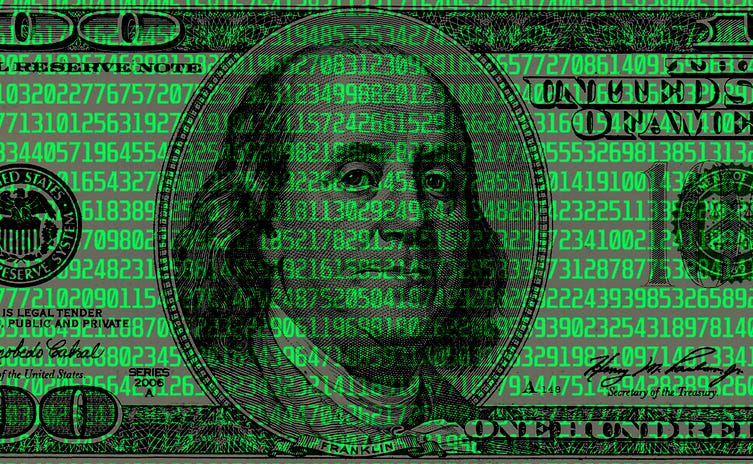
The anxiety surrounding this transition is deeply rooted in the rise of programmable money, the very digital rails toward which the global financial architecture is shifting. When money is self-writing software, it becomes the ultimate instrument of behavioral enforcement. We have already witnessed the analog precursor: the Canadian government weaponizing the banking system to freeze the accounts of protesting truckers. But a far more profound threshold awaits when money itself, guided by autonomous algorithmic protocols, can programmatically deactivate your purchasing power based on social compliance metrics.
This existential paradigm shift explains the calculated geopolitical migration of figures like Peter Thiel to Argentina. It is not merely a reaction to domestic social unrest, nor a bet on the shifting tides of the Washington power index. Rather, it is a masterclass in structural arbitrage. Javier Milei’s government is actively pioneering the legal framework for “non-human corporations” (Sociedad Automatizada). By granting autonomous AI agents the limited liability and protections of corporate personhood, Argentina is positioning itself to become for AI what the Citizens United decision did for corporations in the US. It turned companies into persons.
Thiel is now turning AI Agents into persons.
By relocating his capital and focus to Argentina, Thiel isn’t hiding from a political cycle; he is building the infrastructure for a world where software can not only write itself but also defend its own assets. If the US or European governments attempt to